


Production of asphalt mixes in 2025
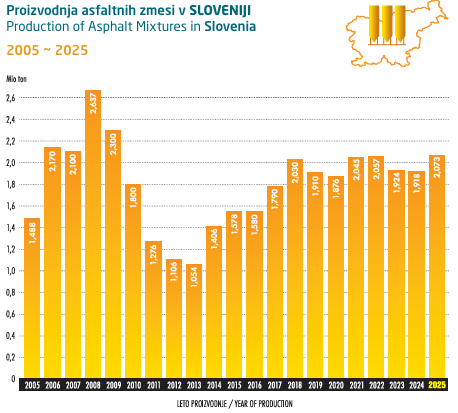
In 2025, asphalt production in Slovenia once again surpassed the two-million ton mark. A total of 2,072,434 tons of asphalt mixtures were produced, representing a moderate increase (8%) compared to the previous year. The number of asphalt plants remained unchanged
last year at 18, with individual plant annual production volumes ranging between 33,000 and just over 300,000 tons. The average annual production per plant was thus approximately 115,000 tons, which is relatively high compared to data from abroad.
For the production of asphalt mixes, more than 1.5 million tons of carbonate aggregate fractions and nearly 400,000 tons of silicate fractions were used. Total consumption of bitumen binders
amounted to 95,500 tons, of which 77,400 tons were paving grade bitumen and just over 18,000 tons were polymer modified bitumen (PMB). The share of polymer-modified bitumen therefore accounted for approximately 19% of the total bitumen binder consumption. This
is comparable to the previous year and reflects the continuous need for asphalt mixes with enhanced properties for road sections under heavier traffic loads.
In the field of recycling, the positive trend of reusing reclaimed asphalt pavement (RAP) in the production of asphalt mixes continues. In 2025, just under 100,000 tons of RAP were used in the manufacturing process, producing more than 260,000 tons of asphalt mixes. This
represents approximately 13% of the total annual asphalt mix production and confirms the growing trend of utilizing
recycled materials in the Slovenian asphalt industry. Compared to 2024, the share of reused RAP increased slightly once again, which aligns with the industry’s focus on more efficient resource management and reducing environmental impacts.
Production of asphalt mixes in EU
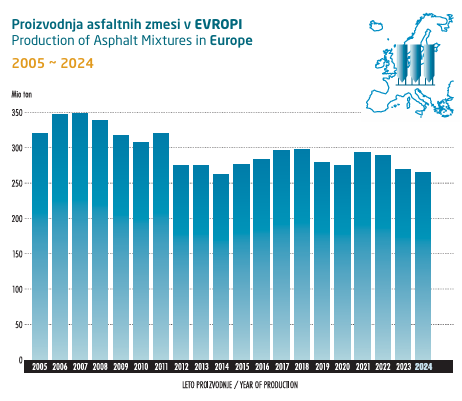
In the European context, the total production of asphalt mixes across the EU 27 countries in 2024 (data summarized from the Asphalt in Figures publication) was estimated at approximately 205.5
million tons. Meanwhile, total production including the United Kingdom, Turkey, Norway, Switzerland, and Serbia reached just over 265 million tons. The largest European producers are Germany with approximately 38 million tons, Italy with 31 million tons, and France with approximately 29 million tons.
Regarding other countries in our region, the year before last, Austria produced 6.8 million tons, Hungary 4.1 million tons, and Croatia approximately 2.9 million tons of asphalt mixes.
In terms of production volume relative to the size of the country, Slovenia ranks highly. However, looking at European trends and increasingly strict environmental requirements, future efforts and
attention must be directed toward increasing the share of RAP reuse and further lowering the production and laying temperatures of asphalt mixes. In doing so, the industry can significantly contribute to reducing raw material consumption and energy intensity, while maintaining the high quality and durability of the road infrastructure.
Premium Partners


